

Decoding of 'Dexter' opening titles!


Audience Research
Top 20 films released in the UK and Republic of Ireland (2011)

The country of origin for the Top 20 films released in the UK and the Republic of Ireland.

The majority of the films originate from the USA, however, the combination of both the UK and the USA are close behind. This shows that the USA made more popular films in 2011, this could be due to various reasons such as larger budget or superior marketing or distribution.
Genres identified in the category of Top 20 films released in the UK and the Republic of Ireland.
Genres identified in the category of Top 20 films released in the UK and the Republic of Ireland.

The most popular genre is adventure, which is closely followed by comedy, action and animation. This shows that the audience preferred to watch films with these genres in as they are evident in the top 20 films released in the UK and the Republic of Ireland (2011). The genre, thriller isn't popular in this category, which could be seen as a positive for me as their is a gap in the market for thriller films to succeed.
Age rating for the Top 20 films released in the UK and the Republic of Ireland.

This pie chart highlights that the majority of films have the rating of 12a. This is done in order to appeal to wider audiences.
Source - http://industry.bfi.org.uk/media/pdf/b/q/UK_box_office_2011.pdf
Top 20 independent UK films released in the UK and the Republic of Ireland (2011)

The country of origin for the Top 20 independent films released in the UK and the Republic of Ireland.

The majority of films originate from the UK, this highlights that for independent films the UK make more popular choices for audiences, this is especially evident for 2011.
Genres identified in the category of Top 20 independent films released in the UK and the Republic of Ireland.

The most popular independent film genre is drama, this is a contrast to the pie chart for non-independent top 20 films. The next most popular genre is comedy, which is popular also in the non-independent top 20 films released in the UK and the Republic of Ireland. The third most popular genre is thriller. This is good for me as this is the chosen genre for my own film, this shows that the genre is popular amongst audiences for independent film makers.
Age rating for the Top 20 independent films released in the UK and the Republic of Ireland.

This pie chart highlights that the majority of the top 20 independent films have the age rating of 15. This indicates that independent films are aimed at an older audience as they contain certain aspects which are not suitable for younger audiences.
Source - http://industry.bfi.org.uk/media/pdf/b/q/UK_box_office_2011.pdf
BBFC Age Rating Categories


Source - http://www.bbfc.co.uk/
These age rating categories apply to me and my film as I have to abide by these rules and take them into consideration when planning the marketing and distribution aspect and also content.
Mise-en-scene Essay on the film 'Seven'
Mise-en-scene plays a very important part in any film. Mise-en-scene is made up of many different sections these are...costume & make-up, character movement & expression etc. I’ve chosen a scene from the film Seven directed by David Fincher, to show how effective mise-en-scene is to create meaning for the spectator.
 The costume and make-up plays a simple part in Seven, the two main protagonists (DC Mills and DC Somerset) wear suits throughout most of the film. The use of suits portrays a very formal and professional sense and fits well with the job that the two main protagonists do. However, their suits are different from each other, which could be seen by the audience as showing their individual personalities. Especially in the scene where we see DC Somerset go round DC Mills’ house for dinner, and you see DC Mils wearing casual clothing but DC Somerset still wearing a suit. The audience may interpret this as DC Mils being a more laid back and relaxed character than DC Somerset. This demonstrates how important costume is, as it helps the audience identify characters preferences, personalities and traits.

Character movement and expression plays an important part in Seven. At one point in the scene, DC Somerset, DC Mills and his wife, all breakout into laughter (after the house is seen to vibrate), which could be seen to be used to be a contrast from the rest of the film. Another aspect that helps make this seen so effective with the use of mise-en-scene is the lighting used. In this scene the lighting is bright and represents what’s going on in the scene. This could be interpreted as happiness and optimism. This is the first time we see the characters happy. Character expression is not exaggerated in this film, which helps the film keep it’s mystery atmosphere. This shows how much of an impact character movement and expression has on a scene as it presents a huge contrast to the rest of the film. In the form of Todorov’s narrative theory, the villain is John Doe, but at the beginning of the film the villain’s identity wasn’t known, which allowed audiences to imagine what the villain looked like and then finally got to see whether they thought correctly or not. The hero or in this case the hero’s are DC Mills and DC Somerset as they are the ones that are constantly tracking John Doe’s movements and in the end kill him which restores equilibrium and the ‘princess’ could be seen as Tracy Mills (DC Mills’ wife) as she is the victim of John Doe. Other types of characters that are not evident in this film are...the false hero, the donor, the helper and the dispatcher. Audiences that are familiar with this theory will most likely pick out the different character types as they watch the film and will identify them with the various characters.
 The lighting but more importantly the weather plays a very important part in Seven. This is seen frequently through the term ‘pathetic fallacy’, which means that the weather represents what’s going on in the scene. Throughout most of the film, it’s raining. Raining can be interpreted in many different ways. In Seven, rain adds effect to the atmosphere and builds tension in specific scenes. This is evident, along with the dim lighting used that the film is a thriller. The use of this could also be interpreted as the equilibrium has been destroyed and the weather is representing this.
Even though camera angles aren’t part of mise-en-scene it still has an effect on the mise-en-scene used and in this scene the camera angles are very basic, apart from when the house shakes, which as the audience you immediately think that it is an earthquake but it just turns out to be the house. This is very effective as the camera is shaking and focusing on certain objects that are also shaking and at the same time there are many different sounds used such as a dog barking, a tapping noise, glasses shaking.
To conclude, mise-en-scene is consistently and effectively used throughout Seven, this is especially seen through costumes & make-up, character movements and expression. The reason why I chose this scene to describe how effective mise-en-scene is, is because the scene contains nearly every aspect of mise-en-scene and makes the scene very important and unique.
Word Count - 751 words.
Cinematography Essay on the film 'Inception'

The film Inception (2010) directed by Christopher Nolan, uses cinematography to make impact the audience in a capturing and thrilling mood. Cinematography includes camera angles such as: long shot, mid shot, close-up, extreme close-up, establishing shot, over the shoulder shot, birds-eye view, point of view, high shot, low shot. All of these shots are used in Inception.
 Mid shots are used in Inception for a variety of scenes such as conversations. During conversations, a majority of the time mid shots are used to give a centre/basic shot. This is because as an audience you only really need to see their face and the top half of their body, in which you can pick up body language and their attitude to what’s being said in the conversation. Other mid shots include the totem (which belonged to the main protagonist, Cobb) spinning, another mid shot is when the main protagonist Cobb and protagonist Ariadne are in a dream and all the boxes etc. burst across the scene and also when they are both walking down the road and on the bridge. The impact mid shots make is very minimal in the sense that they are very simple and used to tell the less dramatic scenes.
  Long shots are used in Inception especially during the hotel scenes where we see Fischer finally trust Cobb. Scenes include looking down the hallways that surround the rooms in the hotel, this is used to show people walking behind the protagonist nearest to the screen, this allows the audience to see what’s happening before the protagonist realises that they are being followed. Another scene where long shot is used, is when the van (containing all the protagonists) drops slowly from the bridge. This allows the audience to see where the van is falling from but also where it’s falling to. This makes an impact on the audience because it highlights the importance of the van falling.
  Close-ups are used to focus on usually just one specific thing/person, the reason for this tends to be because the director wants the audience to all see the same thing. As opposed to, when a long shot is used the audience can pick out different things and may miss something unlike with a close-up. Close-up scenes are used Inception, especially when Cobb is on the beach right at the beginning of the film and then again near the end and also on the plane when Cobb hands Fischer a glass. The use of that shot is to emphasise what is about to happen to Fischer is down to what the glass contains. This impacts the audience because the audience knows something the protagonist doesn’t know, this is dramatic irony. Likewise it allows them to see the thing/person as if it was right next to them, then they become familiar with what they’re seeing.
  Extreme close-ups have the same impact as close-up shots, however, these are even more focused and tend to show emotion and tension in protagonists. Extreme close-up shots are occasionally used in Inception, this is due to the fact that even they were regularly used, they would not have the same impact. Examples of this used is…the very last scene of the film where the audience sees the totem spinning. Throughout the film, the totem is used to symbolise whether the protagonists are in a dream or not. The impact of this is it solely focuses on the totem, which allows the audience to decide whether they are in fact still in a dream or have woken up.
  Establishing shots tend to be used to show the audience where the protagonists are or what they are surrounded by. Establishing shots are frequently used in Inception, this is because the protagonists are constantly travelling to different locations and by using establishing shots, it allows the audience to feel as if they are following their every move. Examples of establishing shots are, when all the protagonists enter the snow level of the dream and an establishing shot is used to show the audience the building and also what surrounds the building, this allows the audience to familiarise themselves with the location. The impact of using establishing shots is it shows the audience where something significant to the film is about to take place.
 Point of view shots are also rarely used in Inception, but also have a huge impact on what the audience sees. Point of view is used to show things the audience wouldn’t normally see, it can be known to ‘track’ the protagonist. Scenes that represent this are; Ariadne falling whilst in the dream and also Cobb descending but then falling down from the hotel room, near the beginning of the film. The impact of using point of view shots is, the audience feel like they are going through the same thing as the protagonist, i.e. if they are falling, the audience feels like they are falling.
  Over the shoulder shots are sometimes used in Inception. The majority of the time they are used during conversations (just like mid shots). The impact of using over the shoulder shots are, it gives the audience an idea what it would be like to be behind the protagonist in the scene and also it is a unique shot that if overused would be less effective and wouldn’t have any impact.
To conclude, cinematography creates meaning, which impacts the audience because of the unique shots used. Without some many different shots used, the film wouldn’t have so much meaning.
Words: 1060
Notes/Essays on films!
Examples of thriller films....Inception, Super 8, Phone Booth, Panic Room.
Different aspects of a film determine what genre they are classified under. Aspects such as lighting, sound, storyline, special effects, cinematography, mise en scene, costume and make up, camera angles and props.
The film 'Phone Booth' is a thriller.

In class we watched a ten minute clip of 'Phone Booth', in that clip we saw the main protagonist answer a telephone in a public phone booth in a busy town centre. After he answers the phone a mysterious voice talks to him. This creates a chilling atmosphere for the audience. As the tension in the clip builds, sound is used to create a sense of panic. The sound used is represents the main protagonists' heartbeat rising as he begins to fear the voice. As the clip continues, we see the main protagonist look around at the buildings surrounding him in hope to see the person who's' voice is on the phone, this is repeated on many occasions throughout the scene, this builds up the characters anxiety. This scene is very effective because the camera pans' up and circles around, which shows the main protagonist surrounded by what seems as thousands of buildings and windows which creates the sense that the character is trapped inside the phone booth.
The film 'Panic Room' is also a thriller.
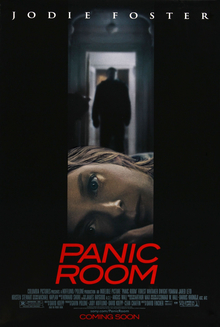
In class we also watched a ten minute clip of 'Panic Room', in that we saw one of the main protagonists' wake up to find three burglars in her house. We then see Jodie Fosters' character chased throughout the house where she wakes her daughter (played by Kristen Stewart) and runs into the panic room in their house. Lighting and sound are a very important aspect to the reason why this film is called a thriller, the film is set in the early hours of the morning when it is still dark outside, there is minimal lighting used in this film, this adds tension because you wouldn't fear this film if it was set in the middle of the day. Also, we saw occasional shots of outside windows, which shows that it is raining outside, you can also hear this in the background noise used. Because the weather outside and the lighting inside the house is very dim, this could be seen as pathetic fallacy, as they both represent the same things. In this film other various aspects add to the tension felt when watching this such as....dark clothes; the three burglars all wear black clothes, black is often associated with fear and lifeless, quick camera angle changes; with the camera quickly moving it represents that things are rapidly changing in the film, lots of doors and stairs; with the use of this it disorientates the audience and especially when music is used to build the suspense of something happening. The chase that happens in the clip we saw, contributes massively to the theme of the film, with the suspension that the music creates and the lack of lighting, the scene is very effective for a thriller film.
'Seven' (1995) directed by David Fincher
Page 1

Page 2

Page 3

'Memento' (2000) directed by Christopher Nolan
Page 1

Unknown (2011) directed by Jaume Collet-Serra

Setting: Berlin, Germany...
There are many settings in this film such as, the Hotel Adlon, the Leipzig/Halle Airport, Berlin Central Station, Oberbaum Bridge, Museum Island, Berlin Friedrichstrasse Station etc. I think the reason why the film was set in a country which was completely different to America, especially language was because, I feel it confuses the main protagonist even more, especially as he is not familiar with the surroundings he is in, which adds effect to the idea that he is struggling to remember who he is entirely. This works well as a setting as it captivates the audience in an unusual way.
'Saving Private Ryan' (1998 - Hybrid Thriller)

'The Color Purple' (1985 - Hybrid Drama/Thriller)

In class we watched the first 20 minutes of 'Saving Private Ryan' directed Steven Spielberg. 'Saving Private Ryan' is a thriller. This is because of certain things that occur throughout the film, such as the storyline but also how that is portrayed onto the screen. Sound plays a huge part in making this film a thriller, this is due to it being the only source of sound through major parts of the film, where there is no dialogue present but you can hear certain sounds such as gun shots and grenades/bombs exploding. At the beginning of the film it starts with a character walking through a graveyard filled with white headstones that are exactly the same as each other, whilst the character is walking through the graveyard the sound playing is what you, the audience would associate with war. After the graveyard seen we see the same character appear to have a flashback. Flashback's can be a very important feature in a film, just as it is in this story. The film starts with effectively the ending and then with the introduction of the flashback we see the story behind the first scene, this is why the flashback is required to make this film work. The lighting in this film starts off very bright, most likely in the morning but as soon as we enter the flashback, the lighting reduces to a very dim atmosphere. As the film progresses and we are in the flashback we see what seems like hundreds of soldiers all dispersed in various boats, which then are attacked by the opposition. We hear sounds such as splashes, which represent the gun shots hitting the water as the soldiers are being ambushed. Other sounds such as grenades/bombs exploding are effective not just because of the noise they make but the scenes that go with them, normally the associations with those sorts of sounds you would expect to see blood and bits of debris blasted into the air, which appear alongside with the sound effects in this film. Sounds such as screaming suggest pain and fear, which help to make this film a thriller, as it builds tension and a sense of panic for the audience watching. At one point in the film you see Tom Hanks' character, appear to be experiencing a sort of trance where the camera focuses on him entirely and his reactions to what is going on around him, the sound is very blocked out in this scene, you can faintly hear screaming and gun shots in the background, but it sounds like it's far away in the distance. There is a lot of obtrusive editing in this film with the camera constantly moving back and forth to the bunker of the opposition and the soldiers. As the audience you regularly feel like the camera is in first person, as you feel you're not just observing the battle but you are part of it.
'The Color Purple' (1985 - Hybrid Drama/Thriller)
In class we watched a 20 minute clip of 'The Color Purple' directed by Steven Spielberg. 'The Color Purple' is a drama/thriller. The story is about a girl named Celie who is abused by her husband from a very young age. The film is set on a farm which contributes to the sound aspect hugely, this is because a lot of the background noises are that of various animals. At the beginning of the clip we watched, we see the main protagonist, Celie, playing with her younger sister Nettie, both of them are singing and the background music used is very happy, the lighting is very bright as they are outside in the height of the day. With both of these aspects present at the same time, it would suggest that Celie is happy. However, as the film continues we see Mr (Celies' husband) on a horse chasing Nettie, in between the two characters is a row of trees which separates them, the trees act as a shield/barrier between them. However, the trees regularly block Netties' view of Mr, which brings an element of surprise into the scene and the chase is also fast pace and quick camera changes is used to show both sides of the trees, this is the use of obtrusive editing. As the scene continues we see Nettie and Mr struggling as he is trying to grab her, the camera doesn't follow them which is where the sounds used are important as we as the audience have to rely on the associations we make with certain sounds such as screaming, to figure out what is happening. Later on in the clip we see the use of shadows, where we see the main protagonist as a child sit down onto a chair as a shadow and then the shadow suddenly grow into a woman. Also, the use of shadows could be interpreted as representing Celies' life. This then creates a jump forward and we see that all the characters have also got older in the jump forward. Obtrusive editing is used in a specific scene where Celie is shaving Mr and the postman is approaching their house to deliver their mail. The camera is constantly switching between Celie getting ready to shave Mr and the postman walking up to their mail box. The sounds used in this scene help to build up tension, and cause panic in the audience with the possibility of Celie cutting Mr's face and him beating her for doing so. The lighting used in this film constantly reflects Celies' mood, with the lighting being bright when she is happy and the lighting being dark/dim when she is unhappy.
Films, Scripts & Feedback
'OneMinute'
(first film)
Ideas...
(first film)
Ideas...

Turned into this...
Script
EXT Outside 4:50 Evening
ESTABLISHING SHOT. EMPTY WOODED LANE. NO MUSIC JUST THE SOUNDS OF NATURE, WIND AND BIRDS. NATURAL LIGHTING, SUN SETTING GETTING DIM.
EXT Outside 5:00 Evening
MID SHOT – PERSON A RUNNING THROUGH WOODED LANE. DIM LIGHTING, SUN SETTING. COSTUME NORMAL CLOTHING OF JEANS AND HOODIE. NO MUSIC, ONLY SOUND OF FEET RUNNING AND PERSON A PANTING.
Person A:
Please, (pause) no, (pause) stop!
SCREEN GOES TO BLACK. NO MUSIC, JUST THE SOUND OF SOMEBODY BREATHING.
EXT Outside 5:30 Evening
MEDIA ACTIONS
Person A:
Speech
ACTIONS
EXT Outside 6:00 Evening
VERY WIDE SHOT. PERSON A RUNNING OUT OF A WOODED LANE AND INTO AN OPEN FIELD. MUSIC STARTS. LIGHT PIANO MUSIC THAT INCREASES IN SPEED.
Person A:
Nooooooooooooooooo!
CAMERA PANS UP TO SHOW THE SKY. PIANO MUSIC STILL PLAYING, NOW QUITE LOUD AND FAST. EFFECTS – TITLE OF FILM PANS UP WITH THE SKY AND STAYS THERE FROZEN IN THE SKY FOR 5 SECONDS. SCREEN GOES BLACK.
Feedback...
From Sam, Dan and Craig
General Feedback:
- Good background soundtrack
- Good use of audio/voice-overs
- Recording quality is poor
- The cut of Emma smothering Dan is awkward
- The close-up on Dan's face is effective
- Dan's acting is positive
- Dan did not drive 75mph in his shot
Improvements:
- Story should be more coherent
- One particular shot felt strange (Emma coming up behind Dan)
- Acting (smiling while strangling someone)
Successes:
- Audio (soundtrack and voiceovers)
- Generally the shots were very good
- The cuts from each shot were smooth
From Harry's Group
General Feedback:
- Good film, narrative got across well.
Improvements:
- Emma needs to stop smiling.
Successes:
- The repetitive noise adds a good effect to the film.
- Narrative is good, audio quality is good.
- Background music isn't too loud and adds tension to the film.
- Acting was good.
For Nicky's Group
General Feedback:
- The film was enjoyable and easy to watch.
Improvements:
- An improvement could have been to involve talking.
- Also, I think at the end of the film instead of just having 'Message Error' appear in front of the phone, it could have had more affect if it had appeared on the actual phome, as if a text message had just been received.
Successes:
- When the music was introduced it was a shock and built the tension up rapidly. This especially happened when the heartbeat was added. Also, when 'Message' appeared on the screen it was in the colour of red, which is associated with danger.
- The use of black and white throughout the film made the film feel more like a thriller and made you fear what could happen.
For Vic's Group
General Feedback:
- The film was very enjoyable and easy to watch.
Improvements:
- There could have been sound effects such as when a character was punched, shot and fell to the ground, as this would make the scene more effective.
- The storyline could have also of been more detailed, this would provide more.
Successes:
- The music went really well with what was happening, it added effect to the film.
- Also, the black and white scene contrasted well with the colour scenes.
For Sam, Dan and Craig
General Feedback:
- A good film that used a lot of mise-en-scene.
Improvements:
- Could use more character expressions to help tell the story.
Successes:
- The noise of the telephone created suspense.
- Used a good use of props, i.e. the knife!
- Clever use of lighting, especially the use of a torch throughout most of the film, then the transition to full lighting, added suspense.
'Safe'
(second film)
Ideas...

Turned into this...
(second film)
Ideas...
Turned into this...
Script
EXT Outside 8:00 Evening
WIDE SHOT AT BUILDING. DARK. PAN DOWN TO SHADOW WALKING. SIMPLE EDGY BACKGROUND MUSIC.
EXT Inside Building 8:02 Evening
RESTRICTED SHOT OF INSIDE THE WAREHOUSE. RESTRICTED LIGHTING. CREEK OF THE DOOR SHUTTING. SLAM. DOOR SHUTS. LIGHTS TURN ON. CAMERA MOVES FORWARD TO PERSON A TIED UP ON A CHAIR IN THE MIDDLE OF THE WAREHOUSE, WEARING A SUIT COVERED IN BLOOD.
Person A:
*slowly tilts head around*
Owwwwwww!
CAMERA PANS ROUND TO PERSON B WHO’S JUST STANDING THERE, WEARING ALL BLACK CLOTHING, HOOD UP COVERING MOST OF FACE.
EXT Inside Building 8:05 Evening
PERSON A IS STILL TIED UP AND PERSON B IS STILL STOOD IN FRONT OF HIM. ALL LIGHTS GO OFF SUDDENLY. THE LIGHTS THEN SWITCH BACK ON ALMOST IMMEDIATELY. ALMOST BLINDING ALL OF THEM. PERSON C IS STOOD BEHIND PERSON A, DRESSED IDENTICALLY TO PERSON B.
Person C:
“What’s the code?”
Person A:
*voice shaking*
“What code?”
Person B:
“YOU KNOW WHAT CODE!”
*pushes the chair over, Person A falls to the ground still attached to the chair*
MUSIC BUILDS. PERSON B AND C, BOTH WALK AWAY TO TALK.
EXT Inside Building 8:10 Evening
PERSON B AND C START TO WHISPER TO EACH OTHER. WHILST THEY’RE TALKING PERSON A IS SILENTLY LOOSENING THE ROPES THAT ARE JOINING HIM TO THE CHAIR. MUSIC IS BUILDING TO A PANIC. CAMERA IS CONTINUOSLY SWITCHING FROM PERSON B AND C TALKING AND PERSON A TRYING TO ESCAPE.
Person B:
“I know he knows the code”
PERSON A IS UNTIEING THE ROPE. MUSIC IS STILL BUILDING.
Person C:
“Maybe we got the wrong guy”
PERSON A IS SET FREE, GETS UP AND RUNS TOWARDS THE DOOR WHICH IS SLIGHTLY OPEN, SHOWING A RESTRICTED AMOUNT OF LIGHT FROM AN OUTSIDE FLOOD LIGHT. MUSIC IS PANICKING TO KEEP UP WITH THE PACE OF PERSON A.
EXT Inside Building 8:14 Evening
PERSON B AND C REALISE THAT PERSON A HAS ESCAPED AND START TO CHASE AFTER HIM. CAMERA PANS AROUND FROM PERSON B AND C TO PERSON A RUNNING. THE MUSIC IS STILL FOLLOWING THE PACE OF THE FILM.
Person B:
“Quick, he’s getting away!”
LAST SHOT IS OF PERSON A ESCAPING THROUGH THE DOOR. THE MUSIC FADES TO SILENCE.
Feedback...
From Sam, Dan and Craig
General Feedback:
- The film as a whole worked very well, it was very flowing and easy to watch. The concepts of a thriller are clear and the thought taken into mise-en-scene had an effective impact.
Improvements:
- The acting could have been better, but with no budget or actors i'm not expecting any fireworks.
- What code?
Successes:
- Mise-en-scene: the choice of set, dark lighting and the prop of the wooden bar were effective.
- The use of dialogue between two characters.
- The camera angles are really good and innovative.
From Nicky's Group
General Feedback:
- It had very good ideas, a lot of mise-en-scene and was very well constructed.
Improvements:
- It was quite hard to hear the dialogue, it wasn't entirely auditable, try to speak a bit louder and clearer.
- It was hard to read the credits and the end, perhaps you should have made them scroll.
Successes:
- Good use of darkness with the torch light shining, I think this added a nice effect, and sets a good atmosphere.
- Really good camera angles, they made the film look really good.
- Good concept, good ideas.
Well done guys :)
For Nicky's Group
General Feedback:
- A very good film. That had a lot of content which made it interesting and very easy to watch, with a good use of mise-en-scene.
Improvements:
- The speaking used could have been a bit clearer, which is something that could be easily modified for future references.
Successes:
- The camera angles were good and complemented the storyline well. The colour contrast of the stabbing scene added effect to the film and made the scene unique.
My Analysis
The task was to create a one minute short film in the same group as in our previous film, of which we had to use the genre, thriller and focus it on the use mise-en-scene. We had two weeks in which to write the script, film and edit the final cuts.
Mise-en-scene is a French term from the theatre and means 'putting on stage'. However, in film terms it refers to many visual elements within a film. The include the use of props, costume and make-up, performance, setting and lighting.
Props: For props we used a torch, rope, a chair, a block of wood with polystyrene around it and a hammer. The use of the torch was important as it also created lighting which was used to focus on Person A and blank out the rest of the setting. The rope was used to show that Person A could not move which also highlighted the control that Person B and Person C had over him. This aswell as the use of the chair, help tell the storyline. The use of the block of wood and the hammer, was to represent violence and the sense of danger
Costume & make-up: We didn't use make-up but we did use basic costume. Person B and Person C were dressed all in black and had hats on. This was to create the sense of mystery, and for the audience to question what the people actually look it. This adds effect to a scene and makes it a more of a thriller. Next time we would have Person A covered in blood and cuts etc. to make it seem as if he'd been beaten which would also add to the sense of mystery.
Performance (character movement and expression): Person A (tied to a chair) has very little movement until the end of the film when he finally escapes. Before that scene, we see him struggle with the ropes that are restricting his movement, this makes the audience start to fear and wonder whether he will escape or stopped by Person B and Person C. This builds tension to the end of the film, which emphasises on the focus of mise-en-scene and also the genre of thriller. The very last scene is the chase scene, I feel this was important to have, as the audience always wants the victim to escape. Next time we would possibly add in a struggle between Person A and Person B/C as this would make a scene that would really impact the film. The character expression used was very basic, it included mainly Person A just seen to be in pain when struggling with the ropes tying him to the chair and also when hit by Person B. Person B and Person C aren't seen to using many expressions, which would be something we would improve next time.
Setting: Originally we planned to find a disused warehouse, however, with the little time we had we couldn't locate a warehouse, and instead used a garage as we thought this would be a perfect alternative and would work just as well. Most of the film is set inside the garage and with every scene the audience gets to see more and more of the garage, which makes an impact on the film entirely as the audience gets to know the setting, which is an important aspect of any film. Other settings include outside the garage, where the first shot is set and also where Person B and Person C are having a conversation outside. It was important to have scenes outside of the garage so the audience got to see what surrounds the garage. Next time we would maybe try to find a larger garage/warehouse etc. this is due to the amount of space we had restricted some possible scenes.
Lighting: At the beginning we used minimal lighting to create a dark and tense atmosphere. One aspect of lighting is the use of the torch at the beginning of the film, this was used to solely focus on Person A. This was then contrasted to scenes shot inside the garage had very bright lighting, which allowed us to emphasis the atmosphere and every little detail inside the garage. Lighting played a very important part in the film as we could not of portrayed the same scenes in a thrilling way. The last scene and the lack of lighting used worked well together as the audience can't see where the characters are running to which creates a sense of fear and wonder. We originally planned to shot the first scene differently (as referred to in the script) and use a shadow to show Person B and Person C walking up to the garage, I think that if we were to do this again, we would use that as our first scene instead.
'Killer'
(third film)
(third film)
Feedback...
Feedback from Dan, Sam & Craig!
Sound Used:
Good:
- Continuation of sounds.
- Sound bridge used.
- The snapshot sound was effective.
Bad:
- Didn't build enough to create tension effectively.
Feedback from Vic, Jon, Amy and Nicky!
Sound Used:
Good:
- Cinematography was good.
Bad:
- Didn't represent what was happening.
- There were no sound effects.
- No sound bridging.
- No tension was built by sound.
Feedback from Callum, Matt, Dan & Harry
Sound Used:
Good:
- Heartbeat used mimicked emotions.
- Sound affects such as the gate opening.
- Footsteps added tension.
- Used both non-diegetic and diegetic.
Bad:
- The sound of the footsteps weren't in time with what the audience could see on the screen.
Reflection of mine, Kelly & Dan's film!
Good:
- The sound used grew louder as the film progressed.
Bad:
- There was no climax with the sound so tension wasn't built.
- Sound affects weren't used to demonstrate what was going in the scene.
